Okay Without the Game Called Again#q=lemongrass in Uniontown Pa

I was a fool for mentioning video games in the first identify. I would never express an stance on a moving picture I hadn't seen. However I declared as an axiom that video games tin never be Art. I still believe this, but I should never have said and so. Some opinions are best kept to yourself.
At this moment, 4,547 comments have rained downward upon me for that blog entry. I'k informed by Wayne Hepner, who turned them into a text file: "It'due south more than than Anna Karenina, David Copperfield and The Brothers Karamazov." I would rather have reread all three than vet that thread. Notwithstanding, they were a skilful prepare of comments for the most part. Mayhap 300 supported my position. The rest were united in opposition.
If yous assume I received a lot of cretinous comments from gamers, you lot would be wrong. I probably killed no more than a dozen. What you see at present posted are nigh all of the comments sent in. They are mostly intelligent, well-written, and right about one affair in detail:
I should non take written that entry without beingness more familiar with the actual feel of video games.
This is inarguable. Many of the comments continued by debating the definition of art, which, information technology was pointed out, I never provided. Many others defined fine art in terms that would include video games. I received dozens of names for video games that the posters said had affected them similar art, and they told me why. Three or four games came up time and once more.
In my bodily experience, I take played "Cosmology of Kyoto," which I enormously enjoyed, and "Myst," for which I lacked the patience. Both games are from the infancy of the grade. I'd played no others because--well, because I didn't desire to. I particularly didn't desire to play ane right now, this moment, on demand.

Gamers tried to arrive easy for me. Kellee Santiago, whose talk in defence force of video games was the bailiwick of my entry, offered to transport a selection of games. Simply I didn't take a game machine. No problem. I heard from my fellow Chicago movie critic Steve Prokopy, amend known as Capone of Ain't Information technology Absurd News. He has a friend who works at Sony Games, and through this friend I was offered a PlayStation 3 unit and a copy of "Bloom," which Santiago produced. To install information technology and brief me, Steve would bring over Simeon Peebler, the chair of Games and Interactive Media at Chicago's Tribeca/Flashpoint Academy. Steve had the box waiting at his place, pre-loaded with several games.
I stalled. I said I was headed for Cannes. I said I wasn't sure I should accept a gift from Sony. He said he'd expect until after Cannes. He said he'd encounter that the PlayStation was sent back to Sony when I was finished with it. I replied: "Gee, Steve...I dunno...sigh..."
Actually, I did know. I knew (1) I had no desire to spend xx to xl hours (or less) playing a video game, (2) Whether I admired it or non, I was in a lose-lose position, and (3) I was too damned bull-headed. I estimate the PlayStation is waiting for me fifty-fifty now in Capone's vault.

My error in the first place was to think I could brand a convincing argument on purely theoretical grounds. What I was maxim is that video games could not in principle be Art. That was a foolish position to take, specially every bit it seemed to utilise to the entire unseen time to come of games. This was pointed out to me perchance hundreds of times. How could I disagree? Information technology is quite possible a game could someday be smashing Fine art.
I was accused of non responding in detail to the arguments against me. This is the gratitude you go for responding to comments at all. I didn't answer considering I was at Cannes, because information technology was taking then much time simply to vet and post the comments, and because...well, what could I say? The entry had expressed everything I had to say without going to the farthermost of really playing a game.
I first expressed my opinion on video games in 2006. At a 2007 "Hollywood and Games Peak" conference, the filmmaker and game auteur Clive Barker responded to some of my statements. Under the circumstances, he was quite civilized. I responded, and you will detect the link below. Barker studied English and philosophy at Liverpool, and understood where I was coming from. He said:
"I retrieve that Roger Ebert'south trouble is that he thinks you can't accept art if there is that amount of malleability in the narrative. In other words, Shakespeare could not have written 'Romeo and Juliet' every bit a game because it could accept had a happy ending, you lot know? If only she hadn't taken the damn toxicant. If merely he'd have gotten at that place quicker."

Well, aye, that is what I think. In that location was actually a time in history when a version of Romeo and Juliet was performed with a happy ending, and I can't begin to tell you how much that depressed audiences.
Barker: "Let'due south invent a earth where the player gets to go through every emotional journeying available. That is art. Offering that to people is fine art."
Ebert: "If yous tin can go through 'every emotional journeying available,' doesn't that devalue each and every one of them? Fine art seeks to lead you to an inevitable decision, non a smorgasbord of choices. If side by side time I take Romeo and Juliet go through the story naked and standing on their easily, would that be way absurd, or what?"
Okay, I was being snarky. I imagine Baker would exist the first to hold his instance of Romeo and Juliet was not an ideal i. Sooner later on these arguments all get effectually to Shakespeare, and have a style of running aground on him. If I could save the works of Shakespeare by sacrificing all the video games in beingness, I would practice it without a moment'south hesitation. I suspect Clive Barker would, as well.

But in that location are many forms of high fine art, and they have appeared at many times. The conscious cosmos of art seems to be one area in which humans have a monopoly among living beings. Perhaps the turning point in our evolution as a species came when we grew capable of creating art and stories; I illustrated that web log entry with prehistoric cave paintings, only to have a gamer describe them equally "scribbles." Well, there'southward one in every crowd.
Who was I to say video games didn't take the potential of becoming Art? Anytime? There was no understanding among the thousands of posters almost fifty-fifty one current game that was an unassailable masterpiece. Shadow of the Colossus came closest. I suppose that's the one I should begin with.
But many other games were too mentioned. If I didn't admire a game, I would be told I played the incorrect 1. Consider what happened when I responded to the urging of a reader and watched Kellee Santiago'southward TED talk. It would finally convince me, I was promised, of the art of video games. I watched it. But noooo. Readers told me I had viewed the wrong talk about the wrong games. Besides, arguing with a You Tube video was pointless if I had never played a game.

They had me in that location. And I didn't want to play a video game. If I should dislike it, I already had a preview of the response awaiting me: I was too erstwhile, I was over the colina, I was too anile information technology "become it." That became the mantra: "Ebert doesn't get information technology." I disagreed with them nigh historic period, which I know more than well-nigh than almost of them, but I had some sympathy about the concept of not "getting it." There are many, many things I believe many members of our society don't "get," only I don't recall they're too old or also young to "get" them, only differently evolved.
One baroque exchange with a reader led to a debate nearly whether Marker Twain himself valued Huckleberry Finn above a tabular array game he had been trying to invent. "Show me a man who believes a game can have more value than Huckleberry Finn," I wrote, "and I'll show you a fool." This argue became reduced to a squabble about semantics and technicalities, and in a quixotic moment I put the question to a vote, devising an online Twitter poll which asked readers which they would value more, a great game or Twain'south great novel.
Of course this poll inspired dozens of complaints that information technology was simplistic (it was) and stupid (likewise truthful), and comments such as "if it were another novel yes, merely not Huck Finn." The first wave of responses showed Huck leading video games 70% to 30%. But those would have been from among my first-line Twitter followers. I asked others to re-tweet it every bit well, and equally the sample grew the numbers shifted.

I tweeted and was re-tweeted two more times. At 11:14 p.m. CDT on June 30, I declare these the concluding results:

Which of course proves cypher.
1 thing I brought from this experience was that I lacked a definition of Art. I've been thinking about that for a couple of months now. There are endless theories of Art, many of them supplied by readers in the thread. The preferred dictionary definition is:
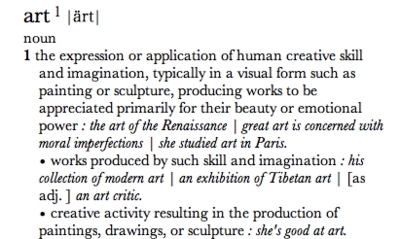
This might exclude video games on a technicality (are they works to be appreciated primarily for their dazzler or emotional power?), but that won't do. I required a definition that would exclude video games (those up to this point, anyway) on principle.
I thought about those works of Art that had moved me most deeply. I establish most of them had one thing in common: Through them I was able to learn more about the experiences, thoughts and feelings of other people. My empathy was engaged. I could utilise such lessons to utilise to myself and my relationships with others. They could instruct me most life, love, disease and death, principles and morality, humour and tragedy. They might make my life more deep, full and rewarding.
Not a bad definition, I idea. Just I was unable to say how music or abstract art could perform those functions, and yet they were Art. Even narrative fine art didn't qualify, because I hardly look at paintings for their messages. It'southward not what information technology's about, but how it'due south about it. As Archibald MacLeish wrote: A poem should not mean, just be.
I ended without a definition that satisfied me. I had to exist prepared to agree that gamers tin can have an experience that, for them, is Art. I don't know what they can learn well-nigh another human being that fashion, no matter how much they learn about Human being Nature. I don't know if they tin exist inspired to transcend themselves. Perhaps they can. How can I say? I may be wrong. but if 'm not willing to play a video game to find that out, I should say and so. I have books to read and movies to see. I was a fool for mentioning video games in the first identify.
The earlier article nigh Clive Barker. My earlier blog almost video games. FWIW, y'all are nevertheless welcome to vote in my meaningless poll.

Roger Ebert
Roger Ebert was the moving picture critic of the Chicago Sun-Times from 1967 until his expiry in 2013. In 1975, he won the Pulitzer Prize for distinguished criticism.
Latest blog posts




Latest reviews
Comments
Source: https://www.rogerebert.com/roger-ebert/okay-kids-play-on-my-lawn
0 Response to "Okay Without the Game Called Again#q=lemongrass in Uniontown Pa"
Post a Comment